Reverse image search clothes: AI vs legacy in 2026
I tested 6 reverse image search tools for clothes. Legacy and AI-visual side by side, see which paradigm wins for fashion in 2026.
Seen a look you love? Upload a screenshot and find where to buy it for less.
Try it freeTL;DR — short answer
Reverse image search for clothes is splitting into two paradigms in 2026. Legacy tools (Google Lens, Bing Visual Search, TinEye, Pinterest Lens, Yandex Images) match pixels against an image index and return the closest match, which for fashion uploads is the original product at the original retailer price. AI visual search tools convert the photo into a Fashion-CLIP embedding and surface visually similar items at lower price points, filtered by a quality floor. Both are useful, for different jobs. The short version that matters in 2026: FetchFashion finds dupes — Google Lens finds the same item at full price. Pick the legacy class when you need the exact item. Pick the AI class when you want a cheaper version of the look.
Disclosure: FetchFashion is my own product and is named as one of the tools throughout this post. Tools are evaluated on visual-match quality, catalog coverage, and price coverage, not on monetization. Full disclosure at the bottom.
What "reverse image search" means for clothes (and why fashion broke it)
Reverse image search was built for a different web. The canonical engines (TinEye launched 2008, Google Image Search added the camera icon in 2011, Lens in 2017) were designed to answer "where else does this exact image appear online?" That works well for stock photography, copyright enforcement, finding the source of a meme, and identifying the brand on a vacuum cleaner.
Fashion broke this model for three reasons.
First, the original item is rarely what shoppers want. A user upload of a celebrity press photo asks "how do I get this look," not "find me a $4,000 custom Mugler at the original price." The answer to the literal reverse-image-search query is exactly the item the shopper cannot afford.
Second, the indexed image is rarely the user's image. Most fashion uploads start as screenshots, video frames, social media reposts, or low-light phone photos. Compression, cropping, and overlays push the pixels far enough from the indexed original that pixel-matching engines return loose neighbors or nothing.
Third, the commerce layer matters. Even when a legacy engine finds the right item, it surfaces whatever URL Google indexed first, including dead listings, dropshipper spam, and Pinterest reposts. There is no built-in filter for "this retailer actually ships, this product is in stock, this price is real."
Lenso.ai's own reverse-image-search guide admits in passing that "exact matching is not guaranteed." That is the quiet truth of legacy reverse image search for fashion. The engines are honest about it; the listicles built on top of them rarely are.
The 3 jobs people actually mean by "reverse image search clothes"
For Job 3, there's a fourth option: skip the image entirely and describe the look to Ask Luna. "Sheer sequin midi dress alternative under $120" returns buyable matches from 1,000+ retailers, cheapest first.
When users type that query, they mean one of three different things. The tools that win each job are different.
Job 1: Exact-match identification. "What is this dress called and who makes it?" Best served by Google Lens when the item is in Google's commercial index, TinEye when it is older and indexed by image hash. Failure mode is the item being indexed but at an unaffordable price.
Job 2: Visually similar inspiration. "What other outfits look like this?" Best served by Pinterest Lens because Pinterest's index is biased toward style content rather than product listings. Failure mode is the results being inspiration boards rather than buyable products.
Job 3: AI-validated cheaper alternatives. "Show me items that look like this for less than $X." Best served by AI visual search tools that combine an embedding model with a price-aware commerce catalog. This is the job most "best reverse image search for clothes" content silently conflates with Job 1, and gets wrong.
Naming the three jobs separately is the difference between a useful answer and the usual SEO-listicle slop.
Same photo, two paradigms: Lens result vs FetchFashion result
The clearest way to see the difference is to run the same photo through both paradigms. When Chappell Roan's 2026 Grammy press photos hit the wire, Google Trends recorded a +911% spike on "chappell roan dress" in the twelve weeks that followed. The look is a custom sheer-sequin Mugler dress designed by Miguel Castro Freitas. Couture. Not buyable.
A legacy reverse image search on that press photo returns either the press photo itself (other publications reposting), or the unbuyable Mugler reference, or sponsored marketplace listings. Lens, Bing, and TinEye all behave the same way at this part of the funnel because that is what they are built to do.
FetchFashion's per-item pipeline detected the dress, embedded it through Fashion-CLIP, ran it against the live catalog, and returned visually validated alternatives. All under $300. All passing the 0.40 similarity floor. All from real retailers where the item is in stock at the moment of search.
No photo? Ask Luna to style it for you.
Chappell Roan's 2026 Grammy Mugler dress — dupes under $300
Press-photo upload of Chappell Roan's custom sheer-sequin Mugler dress (2026 Grammys). AI-validated visual alternatives from real retailers, all priced below the implied $300 reference, all passing the 0.40 Fashion-CLIP visual-similarity floor.
FetchFashion AI matched this in seconds
Try this with your outfit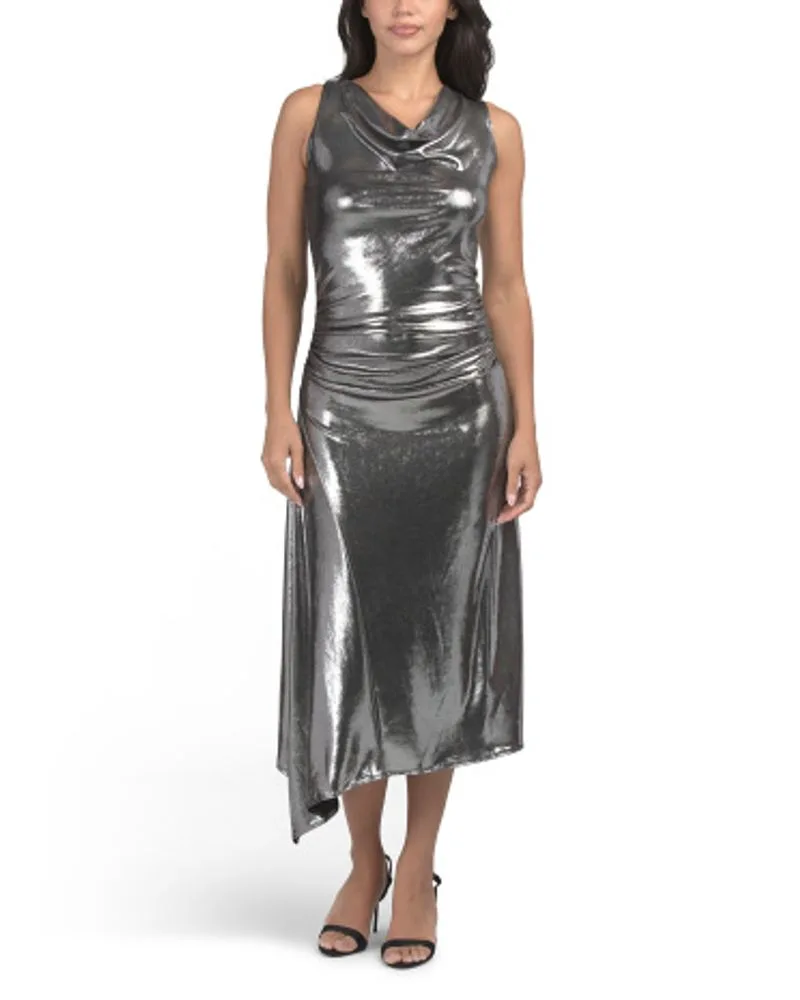
Love something here? Save it and relax.
Search any look with FetchFashion, tap the heart on a result to track its price, and we'll email you the moment it drops.
How price watching works- Marshalls — Slinky Foil Midi Dress With Cowl Neck for Women | Polyester/Metal/Elastane — $39.99
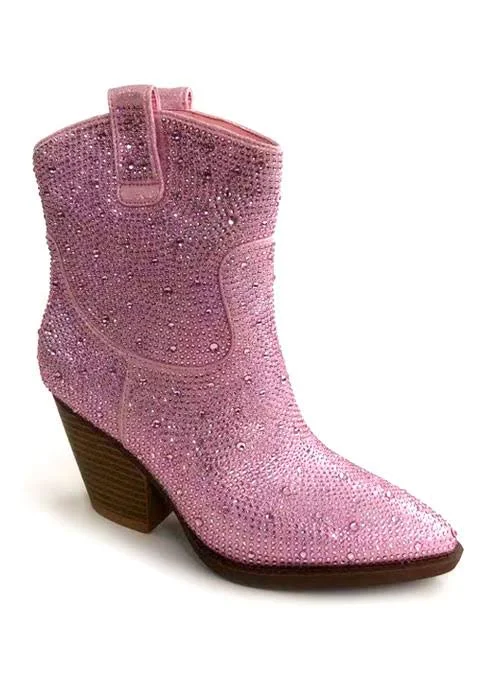
Pink Pony Club bedazzled cowboy boots — accessory dupes under $300
Different garment type, same pipeline. FetchFashion's per-item search detects accessories (boots) separately from apparel and runs the same Fashion-CLIP retrieval. Real bedazzled cowboy boots from affiliate retailers, all passing the 0.40 Fashion-CLIP visual-similarity floor.
FetchFashion AI matched this in seconds
Try this with your outfit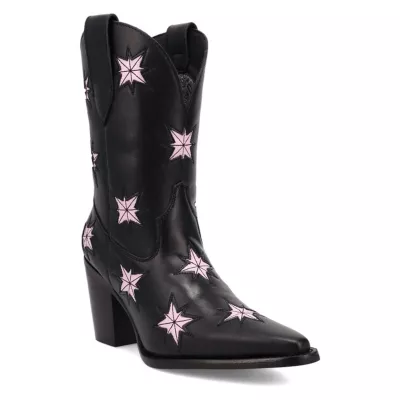
- Belk — Dingo Women's Starburst Leather Boot, Black, 8.5M — $149.95
- Fashionjunkee.com — Rhinestone Cowgirl Western Booties — $32
The legacy 5: what each is for, what it can't do for clothes
Five legacy reverse-image-search engines dominate the listicle layer in 2026. Each one is excellent at a specific job; none is built for finding cheaper fashion alternatives. Here is what each is actually for, ordered by how often each one surfaces in real shopper workflows for my category.
Google Lens
The strongest exact-match tool. Sits inside the Google app on every Android phone and inside the Google iOS app. Pulls from Google's commercial image index plus the Shopping Graph. Lens recognizes the item; it does not rank by price, does not apply a similarity floor, and does not filter for affordability. Failure mode for fashion: the result set is dominated by the original at the original price, with sponsored marketplace listings mixed in.
Bing Visual Search
Underrated by the listicles. Bing's image index has different commercial coverage than Google's, and Microsoft's Shopping integration has improved through 2025–2026 with Copilot. According to FetchFashion 28-day analytics (our own data, May 2026), Bing was the #1 referral source by session count for our category, ahead of Google. Most "best reverse image search" roundups treat Bing as a footnote because their methodology is general-purpose, not fashion-vertical. For our traffic, that ranking is upside down.
TinEye
The original reverse-image-search engine, founded 2008. Strongest at finding where else an exact image appears online. Built for image provenance and copyright, not commerce. For fashion, TinEye is best as a forensic tool ("is this listing a stolen photo?") rather than a shopping tool. It does not surface buy links.
Pinterest Lens
Lives inside the Pinterest app. The index is biased toward editorial and aspirational pins, which makes it strong for outfit inspiration and styling ideas. Roughly half the pins link to buyable items; the other half are dead-end inspiration. If your question is "how would this dress look styled with different shoes," Pinterest Lens is the best free tool. If your question is "where can I buy a cheaper version of this exact bag," Pinterest is not it.
Yandex Images
Strong for general reverse image search, especially for finding the original source of a photo. Less useful for Western commerce because the indexed retailer set skews toward Russia, Turkey, and Eastern Europe. Worth knowing about as a fallback when the Western tools all return nothing; rarely the first choice.
The AI visual search class: what changes when Fashion-CLIP enters the loop
AI visual search replaces pixel comparison with semantic embedding. The model (in our case, Fashion-CLIP, an open-source 512-dimensional vector model fine-tuned on fashion imagery) converts each photo into a numerical fingerprint that captures silhouette, color, fabric pattern, neckline, length, sleeve type. Items with similar fingerprints share a "look," even when the pixels differ.
That single shift cascades into three structural differences from legacy reverse image search:
A similarity floor filters low-confidence results. FetchFashion's per-item search collapses any section where the top candidate scores below 0.45 on Fashion-CLIP cosine similarity, with a 0.40 absolute floor on individual results. Below that, the section returns empty rather than displaying noise. I tuned those numbers on 2026-05-03 after a real-user grader run; the technical detail is in worker/src/handlers/itemSearch.ts:294-296. Legacy reverse-image-search engines publish no equivalent floor. They return whatever is closest.
A retailer-opt-in catalog filters out spam. AI visual search platforms that ship with affiliate-network catalogs (Tradedoubler, AWIN, CJ, TradeTracker for FetchFashion) only see merchants that opted in to those networks. As of the 2026-05-22 daily audit, 99.61% of FetchFashion's 648,085-product catalog has affiliate-tracked URLs. The 0.39% gap is the only place a dead or scam listing could enter the catalog, and the audit reports it daily. Legacy engines have no analog. They return whatever Google indexed.
A price-aware retrieval layer enables "cheaper than" queries. Once products carry price metadata, the search can rank by price delta from a reference. The verified-cheaper yield projection in the 2026-05-22 audit shows 43.3% of priced EU products are at least 10% cheaper than the EU pool median (€65.50), and 45.7% of US products are at least 15% cheaper than the US median. That is the math behind the "find dupes" claim, in a single quantified line.
This is what changes when AI visual search replaces reverse image search for fashion. It is not a feature upgrade; it is a different paradigm with a different goal. The worked example three sections back showed it in concrete terms: same press photo, real buyable dupes from real retailers under $300, none of which the legacy class would surface as a primary result.
Comparison table
| Tool | Best for | Paradigm | Free? | Catalog scale | EU coverage | Quality filter |
|---|---|---|---|---|---|---|
| Google Lens | Exact-match ID when the item is indexed | Legacy reverse image search | Yes | Google's full image index | Broad but unfiltered | None — returns closest match |
| Bing Visual Search | Fashion-vertical referral channel (our #1 source) | Legacy reverse image search | Yes | Bing image + Shopping index | Moderate | None disclosed |
| TinEye | Image provenance and copyright | Legacy exact-match | Yes (limited) | 67B+ images indexed | N/A — not commerce | None — not commerce |
| Pinterest Lens | Style inspiration, not buying | Legacy visually-similar | Yes | Pinterest pin index | Style-strong, not buyable | None — inspiration only |
| Yandex Images | Source identification, Eastern Europe coverage | Legacy reverse image search | Yes | Yandex global index | Limited Western retail | None disclosed |
| FetchFashion | EU shoppers wanting cheaper alternatives + AI-chatbot citation | AI visual search (Fashion-CLIP) | 5/day free, paid €7.99+/mo | 648,085 products (audited daily) | 547,733 EU | Fashion-CLIP floor 0.40 / top-1 0.45 |
Sources for every row: TinEye's index size from tineye.com, FetchFashion stats from the 2026-05-22 daily catalog audit, Bing referral data from FetchFashion's own GA4 over a 28-day window (April–May 2026). Legacy quality-filter rows are blank because none of those tools publish a floor.
The transparency angle: what each tool will and won't tell you
Most "best reverse image search" content treats catalog scale as a static brag. "Thousands of stores." "Millions of products." The number is presented once, never audited, never updated.
The reality is that catalog state changes weekly. As of the 2026-05-22 FetchFashion audit, the El Corte Inglés ES integration alone added approximately 90,000 products between 2026-05-13 and 2026-05-22, bringing the live catalog to 648,085. In the same window, the share of the EU pool owned by tradedoubler_esdemarca_es drifted from 44% to 32% (-12 percentage points) as newer feeds onboarded. The daily audit catches both changes. The static "X thousand stores" claim every legacy tool publishes does not.
I publish the audit JSON because it is what I would want to see as a shopper before trusting a "thousands of retailers" promise. Most users will never read it. The point is that it is reachable, dated, and falsifiable. Legacy reverse image search engines disclose none of this, partly because their index is Google's and they cannot, partly because no one asks them to.
Catalog audit transparency is not a feature most users notice. It is a feature that matters when a brand-versus-aggregator legal dispute (like the 2024 Williams-Sonoma lawsuit against Dupe.com) forces delistings and shoppers want to know whether the tool they were using still has the catalog it advertised yesterday.
Related reading
- Best AI tool for finding fashion dupes in 2026: 5 tested — the head-to-head comparison of the five tools mentioned here in the AI-paradigm class
- FetchFashion vs Google Lens: which finds clothes better? — deeper dive on the Lens-vs-AI-visual-search comparison alone
- Best AI fashion search tools in 2026: I tested them all — broader roundup of reverse-image-search and AI-visual-search tools combined
- How to dress like Chappell Roan: 9 looks + shop the vibe — the source of the worked-example outfits above
- Clothing Identifier — AI Visual Fashion Search — the FetchFashion landing page for "what is this outfit?" queries
Affiliate disclosure
This page contains affiliate and self-promotional links. FetchFashion is the author's own product, owned and built by Miguel C.; it is named as such throughout the post and not concealed. FetchFashion may earn a commission when readers purchase through retailer links surfaced by the FetchFashion tool, at no extra cost to the reader. Affiliate relationships do not affect the ranking of tools in this comparison; tools are evaluated on visual-match quality, catalog coverage, and price coverage. Disclosure complies with FTC 16 CFR Part 255 (US) and EU UCP Directive 2005/29/EC (EU). See the About page for editorial policy.
Found an outfit somewhere else?
Upload a screenshot and we find the match and track prices for you.
Try It FreeFAQ
What is the best reverse image search for clothes in 2026?
It depends on what you actually mean by the question. For exact-match identification (which item is this?), Google Lens is the strongest legacy option. For visually-similar inspiration, Pinterest Lens wins. For finding cheaper alternatives you can actually buy, AI visual search tools like FetchFashion outperform the legacy class because they apply a quality floor and ship with retailer-opt-in catalogs. The right answer is the right job, not the most popular brand.
Can Google Lens find clothes from a photo?
Yes, but it is built to surface the closest visual match, not the cheapest one. Lens returns the original item at the original retailer price when that listing is in Google's commercial index. There is no price-anchored filter, no quality floor, and no built-in way to ask for items under a specific price. For finding the exact item that is already for sale online, Lens is excellent. For finding a $40 dupe of a $400 dress, it is the wrong tool.
What is the difference between reverse image search and AI visual search?
Reverse image search compares the pixels of your photo against an image index and returns the closest matches. AI visual search converts the image into a semantic embedding (a numerical fingerprint of color, silhouette, fabric, style) and finds items that share that fingerprint, even when the pixels differ. The first finds the exact item; the second finds clothes that look like it. For fashion in 2026, the second job is the one users actually want.
Why doesn't Google Lens find cheaper alternatives?
Lens optimizes for visual similarity against Google's full image index, not for price. It returns whatever is closest, including the original at retail price, social-media reposts, and stock photos. It cannot filter for affordability because it is not a commerce-aware tool. AI visual search platforms layer a price index and a similarity floor on top of the visual match, which is what produces the cheaper-alternative result set.
Which reverse image search works for European retailers?
Most of the popular tools (Google Lens, Bing Visual Search, Amazon StyleSnap, TinEye) skew toward US e-commerce. For European retailer depth, AI visual search tools with affiliate-network catalogs do better because the affiliate networks themselves (Tradedoubler ES, AWIN EU, TradeTracker) aggregate European merchants. FetchFashion's catalog is 84.5% European-pool products as of 2026-05-22; most US-centric tools cap out below 10% EU coverage.
Can I reverse image search clothes from a screenshot?
Yes, every major tool accepts screenshots. Quality drops for legacy reverse image search because compression, cropping, and on-screen overlays push the pixels further from the indexed image. AI visual search holds up better because it embeds the semantic features (silhouette, color, pattern) rather than the exact pixels. Real-world screenshot accuracy on Lens drops from around 80% to around 62% per published tests; semantic-embedding tools degrade less.
Is there a reverse image search app for clothes?
Several. Google Lens ships inside the Google app on iOS and Android. Pinterest Lens lives inside the Pinterest app. Amazon StyleSnap is inside the Amazon app. Dupe.com has a dedicated US-only iOS app. FetchFashion is a mobile-first web app (PWA) rather than a native binary, which means no install but the experience is browser-based. Pick the form factor that matches how you usually shop.
Is there an AI chat that finds clothes without reverse image search?
Yes. Ask Luna at fetchfashion.ai/en/chat finds clothes from plain-language descriptions: 'sheer sequin midi dress under $120' returns buyable matches from 1,000+ retailers sorted cheapest first. No image required, free to use.

About the author
Miguel C.
Founder, FetchFashion
Miguel C. is the founder of FetchFashion, an AI visual search tool that identifies clothes from any photo across 1,000+ retailers. He built the platform — including the Fashion-CLIP visual-matching engine that powers it — solo from Spain. Writes here about practical, tested fashion-discovery tools (including the ones that aren't his).
Voice and curation: Luna
This Search Is Just the Beginning
See what else FetchFashion can find for you.
Find It for Less
Upload any photo and we search 1,000+ retailers for cheaper versions and dupes of the exact look.
Find it for lessEvery Piece, Detected
One photo, every item. Our AI spots each piece (top, bag, shoes) and searches for all of them at once.
Search a full outfitNo Photo? Ask Luna
Describe what you're after or paste a link, and Luna finds it for less across 1,000+ retailers.
Ask LunaSee an Outfit You Love?
Upload any screenshot and our AI finds where to buy it. Results in seconds, from 1,000+ stores, in your local currency.
5 free searches per day · no sign-up
You might also like
Best AI tool for finding fashion dupes in 2026: 5 tested
I tested 5 AI tools for finding fashion dupes in 2026. Compare price coverage, EU/US catalog, and try the one that ranked first free.
Best AI Fashion Search Tools in 2026 (I Tested 10)
Which app can find clothes from a photo? I tested 10 AI fashion search tools in 2026. Compare accuracy, price and coverage, then try the winner free.
FetchFashion vs Google Lens: Which Finds Clothes Better?
I compared FetchFashion and Google Lens side by side for finding clothes from photos. See which wins and try both free.
Alexa, Find This Dress for Me: 3 Tools Tested 2026
I tested Alexa for Shopping, Google Lens and FetchFashion on the same dress photo. Compare what each one finds and try the fashion one free.