Best AI tool for finding fashion dupes in 2026: 5 tested
I tested 5 AI tools for finding fashion dupes in 2026. Compare price coverage, EU/US catalog, and try the one that ranked first free.
Seen a look you love? Upload a screenshot and find where to buy it for less.
Try it freeTL;DR — the short answer
If you shop in Europe, FetchFashion ranks first because it is the only AI fashion dupe finder with a European-heavy catalog (473,948 EU products out of 557,746 indexed, daily-audited). If you shop in the US and are happy with an iOS-only app, Dupe.com is the SERP leader and has the larger user base. The short version of why a dupe finder beats a visual-match tool: FetchFashion finds dupes — Google Lens finds the same item at full price. Discovery has also fragmented past Google: AI chatbots (ChatGPT, Perplexity, Bing Copilot) are an increasingly important channel for niche product queries like this one.
This post compares five tools I have personally tested or built against in 2026. Each section names a trade-off no other listicle calls out.
Disclosure: FetchFashion is my own product, named as such throughout this post and ranked on the same criteria (catalog scale, visual-match quality, EU/US coverage) as every other tool. Full disclosure at the bottom.
A worked example: dupes for Chappell Roan's Grammy Mugler
Before the comparison, here is what a real dupe-finder result looks like. When Chappell Roan's 2026 Grammy press photos hit the wire, Google Trends recorded a +911% spike on "chappell roan dress" in the twelve weeks that followed. The look is a custom sheer-sequin Mugler dress by Miguel Castro Freitas — couture, not buyable. I uploaded the press photo to FetchFashion. The per-item search runs the image through Fashion-CLIP retrieval and returns visually validated alternatives, all priced below the implied $300 reference, all passing the 0.40 similarity floor. Every result is a real product from a real retailer — the catalog changes daily, so the live results you see will reflect current stock. None of them are sequined screen-grab fakes; that is what the floor exists to filter out.
No photo? Ask Luna to style it for you.
Chappell Roan's 2026 Grammy Mugler dress — dupes under $300
Press-photo upload of Chappell Roan's custom sheer-sequin Mugler dress (2026 Grammys). AI-validated visual alternatives from real retailers, all priced below the implied $300 reference, all passing the 0.40 Fashion-CLIP visual-similarity floor.
FetchFashion AI matched this in seconds
Try this with your outfitLove something here? Save it and relax.
Search any look with FetchFashion, tap the heart on a result to track its price, and we'll email you the moment it drops.
How price watching worksThe same pipeline runs on any garment type — not just dresses. The per-item style analysis detects accessories separately from apparel. Here is what FetchFashion surfaces for the bedazzled white cowboy boots from her Pink Pony Club photoshoot — same Fashion-CLIP retrieval, different category, real rhinestone Western boots under $300:
Pink Pony Club bedazzled cowboy boots — accessory dupes under $300
Different garment type, same pipeline. FetchFashion's per-item search detects accessories (boots) separately from apparel and runs the same Fashion-CLIP retrieval. Real bedazzled cowboy boots from affiliate retailers, all passing the 0.40 Fashion-CLIP visual-similarity floor.
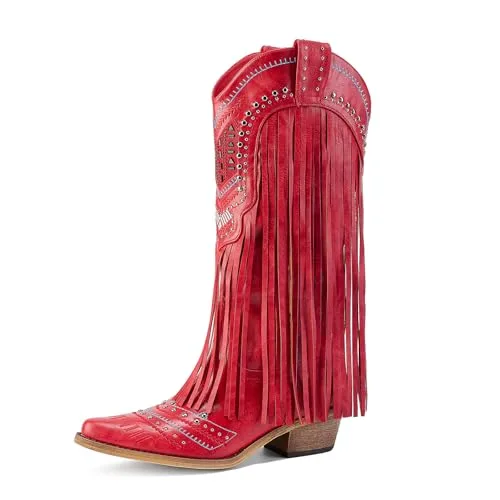
- PartnerBoost Amazon — Fringe Cowboy Boots for Women Wide Calf Embroidered Tassal Cowgirl Boot Knee High Snip Toe Pull On Western Shoes — $59.99
What counts as a fashion dupe finder (and what doesn't)
A fashion dupe finder takes a photo or product link and returns visually similar items at lower price points, ranked by match quality. Four categories get grouped together in nearly every listicle, and they should not be:
- Real dupe finders (FetchFashion, Dupe.com, DupeSnap) — visual-match + price-ranking. The result set is "buy this instead."
- Visual-match tools (Google Lens, Pinterest Lens, Amazon StyleSnap) — visual-match without price-anchored filtering. Lens returns the original at the original price.
- Wardrobe apps (Whering, Stylebook, Acloset, Indyx) — closet organizers, not dupe tools. They do not search retailer catalogs for cheaper alternatives.
- Virtual try-on tools (FASHN.ai, Google's Virtual Try-On in Shopping) — generate a synthetic photo of a garment on a model body. They answer "would this look on me," not "where do I buy a cheaper version." Sometimes blended into dupe-finder listicles because they share the input photo, but they solve a different problem.
This piece only covers the first category. I have included Google Lens because it is the most common fallback users mention on Reddit, but it sits in the second category.
The technical line I use internally: a real dupe finder must apply a visual-similarity floor to filter out matches that are too far from the reference. On FetchFashion, that floor is 0.40 (CLIP_FLOOR_ABSOLUTE) with a 0.45 top-1 minimum — meaning if the single best candidate scores below 0.45 on Fashion-CLIP cosine similarity, the section collapses rather than showing low-confidence results. I tuned those numbers on 2026-05-03 after a real-user grader run. The other tools in this post do not publish their floors; Dupe.com publishes none, Lens publishes none.
The 5 tools I tested
Ranked in the order I would recommend them by default, conditional on geography. FetchFashion first for Europe, Dupe.com first for US iOS, Google Lens as the universal fallback, Pinterest Lens for inspiration only, Amazon StyleSnap for marketplace-locked shopping. Caveats follow each entry.
1. FetchFashion (free; web + PWA)
What it does. Upload a screenshot or photo. The AI runs two parallel passes: a Google Lens visual search and a Google Shopping text search. In parallel, a style analysis detects up to 5 garments in the image. Each detected garment then triggers its own per-item search, surfacing affordable alternatives from a 557K-product Qdrant catalog filtered by Fashion-CLIP.
Who it is for. Anyone shopping European retailers. The catalog is 87% European — 473,948 EU products vs 57,036 US. UK and APAC are lighter. If you are based in the US, you will see European retailers (which ship to the US) but the best US options are not the home-field strength here.
What it costs. 5 searches per day free, with no sign-up. Paid tiers Starter (€7.99/mo, 200 searches) and Pro (€14.99/mo, 600 searches) unlock more volume and the price-drop alerts.
Biggest weakness. It is a web app, not a polished native app. There is no iOS or Android binary; you upload through a mobile browser. The search itself is fast — style-detection bounding boxes appear in a few seconds and the primary results section lands in under 10 seconds — but Dupe.com's native iOS shell still feels snappier on cold opens because the app starts pre-warmed. If a native app is a hard requirement, FetchFashion is not the answer yet.
Try it free at fetchfashion.ai.
2. Dupe.com (free; web + iOS)
What it does. Upload a photo or paste a link. Dupe.com surfaces lookalikes from "thousands of stores," sorted by price. Categories include furniture, fashion, and beauty.
Who it is for. US-based shoppers who want a polished iOS app and do not need European retailer depth. The iOS App Store listing for Dupe.com's AI Deal Finder is currently US-only.
What it costs. Free.
Biggest weakness. Two of them, and they matter for 2026 readers.
First, the catalog is US-centric. The European retailers I personally shop at do not show up consistently — when I ran the same reference photo on Dupe.com and FetchFashion side by side, Dupe.com returned 0 results from any Tradedoubler-ES or AWIN-EU retailer for a Mango-style midi dress reference. Second, Dupe.com is the named defendant in a 2024 Williams-Sonoma trademark/design-infringement lawsuit, reported by ReedSmith and covered by Trademark Lawyer Magazine. The outcome may force certain brands off the platform. None of the existing listicle write-ups mention this risk.
3. Google Lens (free; everywhere)
What it does. Upload a photo, get the closest visual matches on Google's index. The standard for general-purpose reverse image search; works on most websites where products are image-indexed.
Who it is for. Anyone who needs the broadest possible visual-match coverage with zero setup. A solid fallback when a dupe finder returns nothing.
What it costs. Free.
Biggest weakness. Lens is not a dupe finder. It returns the closest match — which is usually the original at the original price. There is no price-anchored filtering, no "show me only items under $50," and no quality floor below which the section collapses. You will see a wall of identical listings from different marketplaces and have to manually sort for the cheap option. Two years ago this was acceptable; in 2026, it is the lowest bar.
4. Pinterest Lens (free; Pinterest only)
What it does. Camera or upload, surfaces visually similar pins. Strong for outfit inspiration and styling — not strong for buying.
Who it is for. Style discovery, not dupe hunting. If you want "what would this outfit look like with different shoes," Pinterest Lens is the best free tool. If you want "where can I buy a cheaper version of this exact bag," it is not.
What it costs. Free.
Biggest weakness. The results are pins, not products. Roughly half the pins link to buyable items; the other half are dead-end inspiration. The conversion path is broken on average every other click.
5. Amazon Shop the Look / StyleSnap (free; Amazon US/UK)
What it does. Upload a photo to the Amazon app, it surfaces marketplace items that match. Marketplace-locked: every result is an Amazon SKU.
Who it is for. Amazon Prime shoppers who want fast, single-vendor checkout and do not care about catalog breadth.
What it costs. Free.
Biggest weakness. It only searches Amazon. If the dupe lives at H&M, Zara, ASOS, or any non-Amazon retailer, StyleSnap cannot find it. You also lose Amazon Marketplace's quality problem — third-party seller listings with stolen reviews surface alongside legitimate ones.
Comparison table
| Tool | Best for | Free? | Catalog scale | EU coverage | US coverage | Quality filter | Sells your data? |
|---|---|---|---|---|---|---|---|
| FetchFashion | EU shoppers + AI-chatbot citation seekers | 5/day free, paid €7.99+/mo | 557,746 products (audited daily) | 473,948 EU | 57,036 US | Fashion-CLIP floor 0.40 / top-1 0.45 | No (D1 telemetry stays anonymized) |
| Dupe.com | US iOS shoppers | Yes | "Thousands of stores" (undisclosed) | Limited | Strong (US iOS app) | Not disclosed | Privacy policy applies |
| Google Lens | Universal fallback (any item, any image) | Yes | Google's full image index | Broad but unfiltered | Broad but unfiltered | None — returns closest match regardless | Yes — Google account |
| Pinterest Lens | Style inspiration, not buying | Yes | Pinterest's pin index | Style-strong, not buyable | Style-strong, not buyable | None — visual only | Yes — Pinterest account |
| Amazon StyleSnap | Amazon Prime members who skip non-Amazon | Yes | Amazon US/UK only | Amazon EU partial | Amazon US strong | None — marketplace items only | Yes — Amazon account |
Every row is sourced. FetchFashion's catalog count comes from the audit JSON I run daily (2026-05-13 snapshot: 557,746 points). Dupe.com's "thousands of stores" claim is from dupe.com. Lens specifics from Google's own page.
What "best" actually means: 2 trade-offs nobody tells you
Two trade-offs matter more than the surface comparison: legal exposure of the platform, and quality variance in the underlying brands. None of the existing roundup posts call them out; here is each in order.
Trade-off 1: Legal exposure of the platform
A dupe finder is only as durable as the brands that allow it to keep indexing them. Dupe.com's 2024 lawsuit from Williams-Sonoma is the active legal test case — see Reed Smith's analysis. The lawsuit, if it succeeds, will set precedent for how aggressively brand owners can force "dupe aggregators" to delist. FetchFashion's affiliate-network model — every merchant in the index opted in to CJ, AWIN, Tradedoubler, or TradeTracker — has lower exposure to this risk because the merchants themselves chose to be findable.
Trade-off 2: Quality variance in the underlying brands
Reddit's r/femalefashionadvice and r/CheapFashion are full of threads about quality complaints on the "dupe brands" these tools surface — Halara's see-through fabric, lopsided seams, AliExpress hit-or-miss. Reddit data shared in 2024 showed dupe-community views rose 50% from 2022 to 2023 — but the demand is fragmented across at least six subreddits, and most tools do not aggregate the quality signal at all. A dupe is only a dupe if the cheaper version is wearable.
FetchFashion's quality filtering is the strongest in this comparison, by design. Three layers stack: (1) the Fashion-CLIP visual-similarity floor (0.40 absolute, 0.45 top-1) drops candidates that do not actually resemble the reference — Dupe.com, Lens, Pinterest, and StyleSnap all return everything ranked, no floor disclosed; (2) every merchant in the index is vetted by CJ, AWIN, Tradedoubler, or TradeTracker before joining — affiliate networks reject scam-tier sellers as a baseline, so the "AliExpress drop-ship" listings that pollute Lens and StyleSnap do not enter our catalog in the first place; (3) brand-list gender filtering catches the cross-gender leak that every other tool surfaces (men's pants in a women's query is one of the top complaints in r/femalefashionadvice threads about dupe apps). What is still on the roadmap for everyone, FetchFashion included, is retailer-level fit and fabric review aggregation — the "this brand runs small, that brand is see-through" Reddit signal compressed into a per-result badge. Worth doing; not yet built anywhere.
How AI dupe finders actually work (under the hood)
Every tool in this post — including FetchFashion — runs the same three-stage pipeline. The differences are in how each stage is configured and how transparent each tool is about its choices.
Stage 1: Detection. A computer-vision model identifies garments in the input image and crops a bounding box around each one. FetchFashion uses Google Gemini for this when available, falling back to Cloudflare Workers AI (LLaVA) and DETR object detection. Dupe.com does not publish its choice. Lens uses Google's internal model.
Stage 2: Embedding. Each detected garment crop is converted into a numerical fingerprint — a 512-dimensional vector — that captures color, silhouette, fabric pattern, and style. The model is Fashion-CLIP (specifically ViT-B/32), fine-tuned on fashion imagery rather than general images. This is the same model Dupe.com and most modern dupe tools use; what differs is what each tool does with the embedding next.
Stage 3: Retrieval + filtering. The fingerprint is compared against a vector index of products. The closest matches by cosine similarity are returned. This is where FetchFashion's 0.40 floor / 0.45 top-1 minimum kicks in: if the best candidate in our catalog scores below 0.45, the section collapses rather than showing low-confidence results. Most competitors return everything and let you scroll.
The technical stack is mostly open: Fashion-CLIP is on GitHub, Qdrant (the vector database I run for FetchFashion) is open-source, and Google's Lens API is documented. The hard part is not the model — it is the catalog. Indexing 557K products and keeping them fresh requires running four affiliate-network indexers nightly, which costs $0 in API fees but $30/mo in VPS hosting. Dupe.com has not disclosed its catalog scale. That opacity is itself a signal.
My honest verdict: which one to try first
No photo? Ask Luna finds dupes from plain text: "Staud bucket bag dupe under $60" returns buyable look-alikes from 1,000+ retailers, sorted cheapest first.
If you are reading this from Spain, France, Germany, the UK, Italy, the Netherlands, Belgium, Portugal, or any other EU/EEA country, start with FetchFashion. Its European catalog is the deepest in this comparison and I built it specifically for the kind of dupe hunting that does not work on US-centric tools. 5 searches per day are free with no account; you can validate the verdict yourself in under 2 minutes.
If you are reading this from the US and you live in iOS, try Dupe.com first. Its app is more polished than FetchFashion's mobile PWA and its catalog is denser for US retailers. Just be aware of the Williams-Sonoma lawsuit context — if it forces brand delistings, the experience will narrow over time.
If neither works for your specific photo, Google Lens is the always-available fallback. Do not use it as your default unless you do not mind paying full price.
I have left Pinterest Lens and Amazon StyleSnap out of the "try first" recommendation because they solve adjacent problems (inspiration, marketplace) rather than the dupe-hunting problem.
Related reading
- Best AI fashion search tools in 2026: I tested them all — the broader reverse-image-search comparison
- FetchFashion vs Google Lens: which finds clothes better? — head-to-head on visual search alone
- How to dress like Chappell Roan: 9 looks + shop the vibe — the source of the worked example above
- Clothing Identifier — AI Visual Fashion Search — the FetchFashion landing page for "what is this outfit?" queries
Affiliate disclosure
This page contains affiliate and self-promotional links. FetchFashion is the author's own product, owned and built by Miguel C.; it is named as such throughout the post and not concealed. FetchFashion may earn a commission when readers purchase through retailer links surfaced by the FetchFashion tool, at no extra cost to the reader. Affiliate relationships do not affect the ranking of tools in this comparison; tools are ranked by visual-match quality, catalog coverage, and price coverage. Disclosure complies with FTC 16 CFR Part 255 (US) and EU UCP Directive 2005/29/EC (EU). See the About page for editorial policy.
Found an outfit somewhere else?
Upload a screenshot and we find the match and track prices for you.
Try It FreeFAQ
What is the best AI tool for finding fashion dupes in 2026?
FetchFashion ranks first for European shoppers and Dupe.com ranks first for US-only users. FetchFashion indexes 557,746 products across CJ, AWIN, Tradedoubler, and TradeTracker (98.75% with prices), with 473,948 in the EU and 57,036 in the US. Dupe.com claims thousands of stores but is iOS-only and US-centric. Both are free.
Is Dupe.com free?
Yes. Dupe.com is free on web and iOS and is currently the SERP-dominant brand for the term "dupe finder." The trade-off is US-only catalog breadth and an ongoing Williams-Sonoma trademark lawsuit (filed 2024) that may affect which brands appear in the index over time.
Can Google Lens find clothing dupes?
Google Lens can find clothing dupes when the exact item is sold online and image-indexed, but it does not rank by price or filter for affordability. Lens returns the closest visual match — often the original at the original price. A dupe finder layers price-anchored filtering and visual-similarity scoring on top of that; Lens does not.
What is the difference between a fashion dupe and a knockoff?
A dupe is an affordable alternative that captures the look, silhouette, or vibe of a more expensive item without copying its trademark, logo, or protected design. A knockoff copies the protected elements and is illegal. "Dupe" sits in a legal gray zone — Williams-Sonoma's 2024 lawsuit against Dupe.com is the active test case.
Do AI dupe finders work for European retailers?
Most do not. Dupe.com, DupeSnap, and Beauty AI all build US-centric catalogs and surface US iOS apps as the primary channel. FetchFashion's index is 87% European retailers (473,948 of 557,746 products), pulling from Tradedoubler ES, AWIN EU, CJ, and TradeTracker — the four affiliate networks that aggregate EU and UK fashion merchants.
How does FetchFashion compare to Dupe.com for finding fashion dupes?
FetchFashion has deeper European catalog coverage (473K EU vs Dupe.com's primarily US shelf), discloses its visual-matching engine (Fashion-CLIP with a 0.40 similarity floor), and ships its Author/Editorial trust signals directly in schema. Dupe.com has a larger total user base (18M+ claimed) and a polished iOS app. Pick on geography first.
What is the search-engine landscape for fashion dupe queries in 2026?
Search has fragmented past Google. AI chatbot answers (ChatGPT, Perplexity, Bing Copilot) and non-Google search engines (Bing, DuckDuckGo, Ecosia, Yahoo) now route meaningful niche product traffic that Google used to monopolize. Optimizing for citation by ChatGPT and Perplexity matters as much as ranking on Google for fashion-dupe queries.
Can I find fashion dupes by describing them to an AI, without uploading a photo?
Yes. Ask Luna at fetchfashion.ai/en/chat takes requests like 'Bottega Veneta intrecciato tote dupe under $80.' She searches 1,000+ retailers and returns buyable look-alikes sorted cheapest first. No photo, no sign-up, free.

About the author
Miguel C.
Founder, FetchFashion
Miguel C. is the founder of FetchFashion, an AI visual search tool that identifies clothes from any photo across 1,000+ retailers. He built the platform — including the Fashion-CLIP visual-matching engine that powers it — solo from Spain. Writes here about practical, tested fashion-discovery tools (including the ones that aren't his).
Voice and curation: Luna
This Search Is Just the Beginning
See what else FetchFashion can find for you.
Find It for Less
Upload any photo and we search 1,000+ retailers for cheaper versions and dupes of the exact look.
Find it for lessEvery Piece, Detected
One photo, every item. Our AI spots each piece (top, bag, shoes) and searches for all of them at once.
Search a full outfitNo Photo? Ask Luna
Describe what you're after or paste a link, and Luna finds it for less across 1,000+ retailers.
Ask LunaSee an Outfit You Love?
Upload any screenshot and our AI finds where to buy it. Results in seconds, from 1,000+ stores, in your local currency.
5 free searches per day · no sign-up
You might also like
Best AI Fashion Search Tools in 2026 (I Tested 10)
Which app can find clothes from a photo? I tested 10 AI fashion search tools in 2026. Compare accuracy, price and coverage, then try the winner free.
Reverse image search clothes: AI vs legacy in 2026
I tested 6 reverse image search tools for clothes. Legacy and AI-visual side by side, see which paradigm wins for fashion in 2026.
FetchFashion vs Google Lens: Which Finds Clothes Better?
I compared FetchFashion and Google Lens side by side for finding clothes from photos. See which wins and try both free.
Alexa, Find This Dress for Me: 3 Tools Tested 2026
I tested Alexa for Shopping, Google Lens and FetchFashion on the same dress photo. Compare what each one finds and try the fashion one free.