How to Find the Brand of Clothes From a Photo
Visual AI matches garments, it can't read labels. Learn how to find the brand of clothes from a photo, and what to do when the label stays a mystery.
Seen a look you love? Upload a screenshot and find where to buy it for less.
Try it freeTo find the brand of clothes from a photo, upload the picture to FetchFashion, an AI visual search tool that identifies each garment and returns visually similar products you can buy across 1,000+ retailers. Here is the part most guides skip: visual AI matches garments, it does not read labels. There is no logo scan and no woven-tag OCR involved. What you get is inference from silhouette, cut, print, fabric and hardware, and a brand name surfaces only when a matched product happens to be the same piece or a very close relative. That works often on a distinctive print and rarely on a plain black tee. FetchFashion finds cheaper alternatives; Google Lens finds the same item at full price. So even when the label stays a mystery, you leave with the piece or something close enough to wear tomorrow. Free for 5 searches a day, no account.
I would rather tell you that upfront than sell you a magic trick that falls apart on the first blurry Instagram screenshot.
Why visual AI can't read the brand off a photo
Brand identification from a photo is an inference, not a lookup. The AI has no access to the label sewn inside the collar. It converts the garment into a numeric fingerprint using a fashion-trained vision model, then finds products whose fingerprints sit closest to it. Fashion-CLIP, the open model family this kind of search is built on, learned garment attributes: neckline, sleeve length, print scale, drape, colour family.
So when the results come back clustered around one particular kind of dress, that is the model saying the shape and print sit in that neighbourhood of its catalogue. It is not reading a tag.
Two things follow. First, a brand can only surface if that brand's product sits in a retailer feed somewhere, in stock, with a photo. A sold-out capsule piece, a runway sample, or a small label with no online feed is invisible no matter how good the model is. Second, your confidence is proportional to how unusual the garment is. Distinctiveness is the whole currency here, and the three sections below are ranked by how much of it each garment carries.
Prints are the strongest brand signal
A loud, specific print is the closest thing a garment has to a fingerprint. Nobody else is printing that exact spot scale on that exact ground colour, so a print match narrows the field to a handful of products fast.
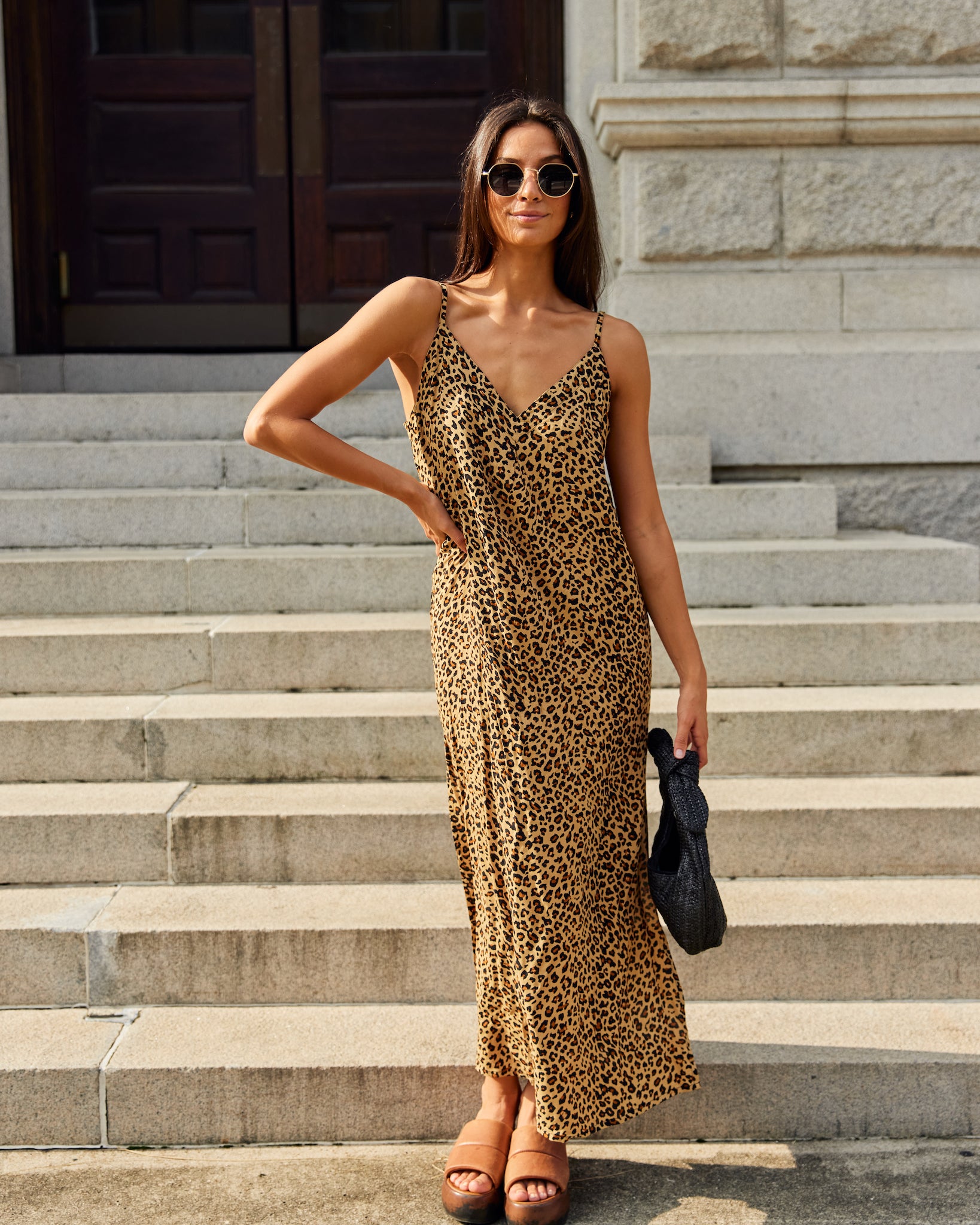
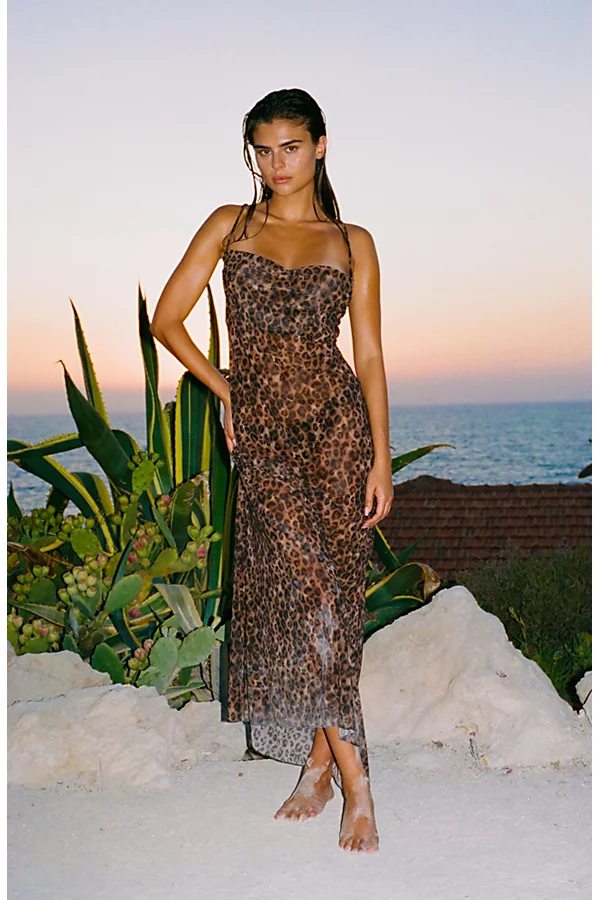
Leopard is the clean test case. I ran a leopard midi slip through the pipeline, and the matches came back at 0.38 to 0.39 visual relevance, the highest scores anywhere in this post. Every product below cleared a 0.33 relevance floor before it was allowed on the page, so those numbers sit well clear of the bar rather than scraping past it.
No photo? Ask Luna to style it for you.
Leopard print midi slip dress
Leopard print midi slip dress, thin straps, bias cut, cowl neckline. A loud, specific print is the closest thing a garment has to a fingerprint.
FetchFashion AI matched this in seconds
Try this with your outfit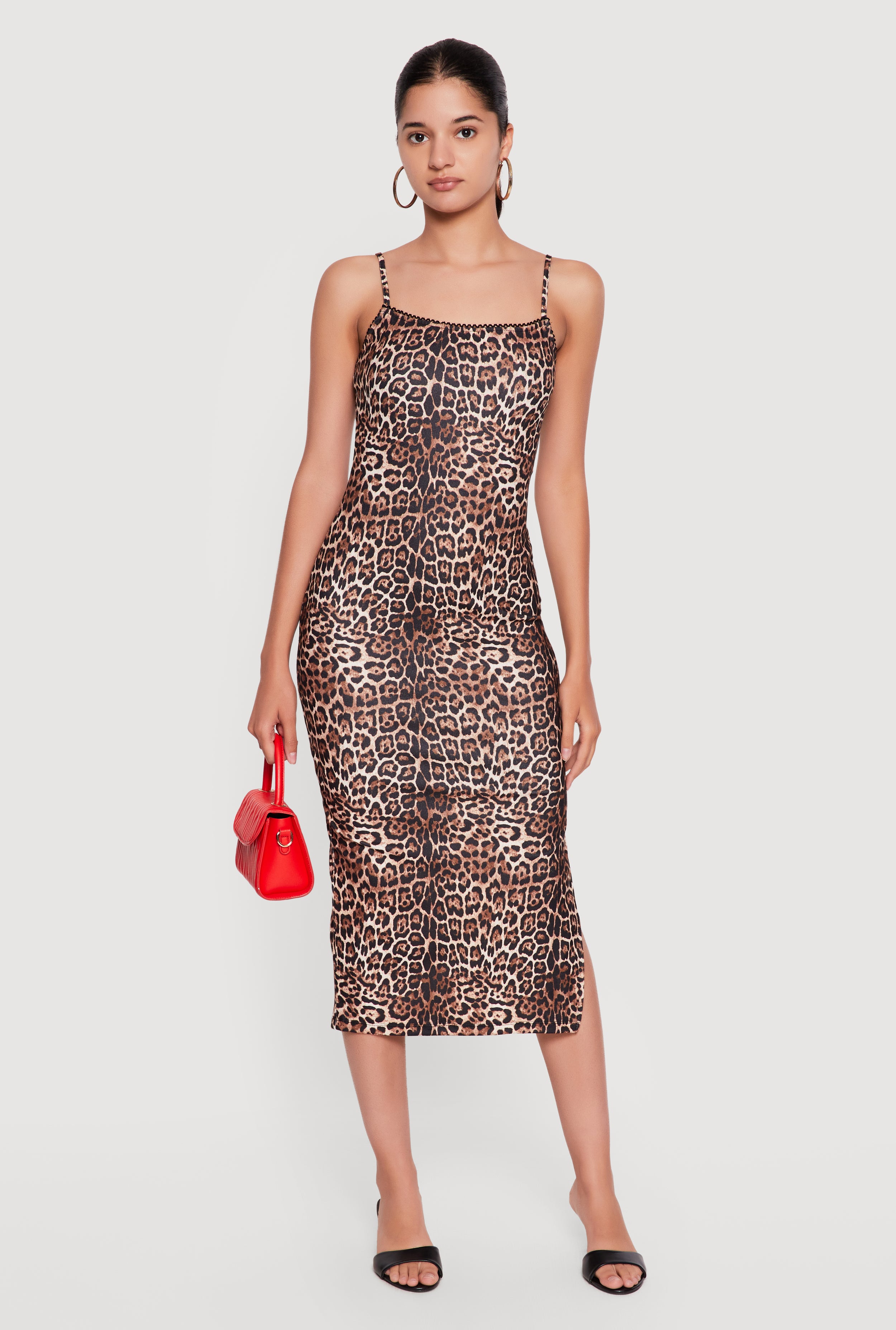
Love something here? Save it and relax.
Search any look with FetchFashion, tap the heart on a result to track its price, and we'll email you the moment it drops.
How price watching worksLook at what that score buys you. Three leopard dresses, all midi or maxi, all strappy, spanning $15.97 to $160. When results converge like this, the top match's brand is a genuinely useful guess, and the ones underneath are your budget route to the same look. That $15.97 Rainbow Shops dress and the $160 Urban Outfitters one are recognisably the same idea, which is exactly the spread you want when the original turns out to be unaffordable or sold out.
How to find the brand of clothes from a photo in 5 steps
To find the brand of clothes from a photo: crop the image to one garment, upload it to FetchFashion, read the match scores, check whether the top results agree with each other, then search the brand names that repeat. The whole run takes about 10 to 30 seconds, and step four is the one that separates a real identification from a guess.
- Crop to one garment. If the photo shows a full outfit, cut it down to the piece you care about. FetchFashion splits a photo into separate garments automatically, and in an internal test run across 9 real photos on 2026-06-07 it detected 2 to 4 garments per image, but a tight crop still gives the cleanest signal.
- Upload it to FetchFashion. Nothing to install, it runs in the browser. Per-item search keeps only candidates at or above a 0.35 Fashion-CLIP similarity floor, so the weakest guesses are filtered out before they reach you.
- Read the match scores, not just the pictures. A high score means the model is confident about the garment, not about the label. Treat it as "how close is this shape and print", because that is precisely what it measures.
- Check whether the top results agree. This is the real brand test. If four of the top five matches are the same silhouette in the same print, you are probably looking at the piece or its direct siblings, and a brand name that repeats is a strong candidate. If the results disagree wildly, the photo did not carry enough information and no brand claim is safe.
- Search the repeating names to confirm. Take the brand that shows up more than once, search it alongside the garment description, and compare the product photo against yours. Buttons, seams, and label placement settle it.
No photo to work from? You can also describe the piece to Ask Luna and she finds it for less, no upload needed. "Beige belted trench, double breasted, knee length, under 120 dollars" is enough to get real product cards back, sorted cheapest first.
Texture is the second-best signal
Knitwear sounds as generic as a plain jumper gets, and it isn't. Knits carry structure: cable width, rib depth, gauge, shoulder construction, neckline shape. A visual model reads all of that, which is why a cream cable knit still matches usefully while a cream jersey top would not.
Cream chunky cable knit jumper
Women's cream chunky cable knit jumper, oversized fit, ribbed cuffs, round neckline, worn by a female model. Heavy texture that reads clearly to a visual model.
FetchFashion AI matched this in seconds
Try this with your outfit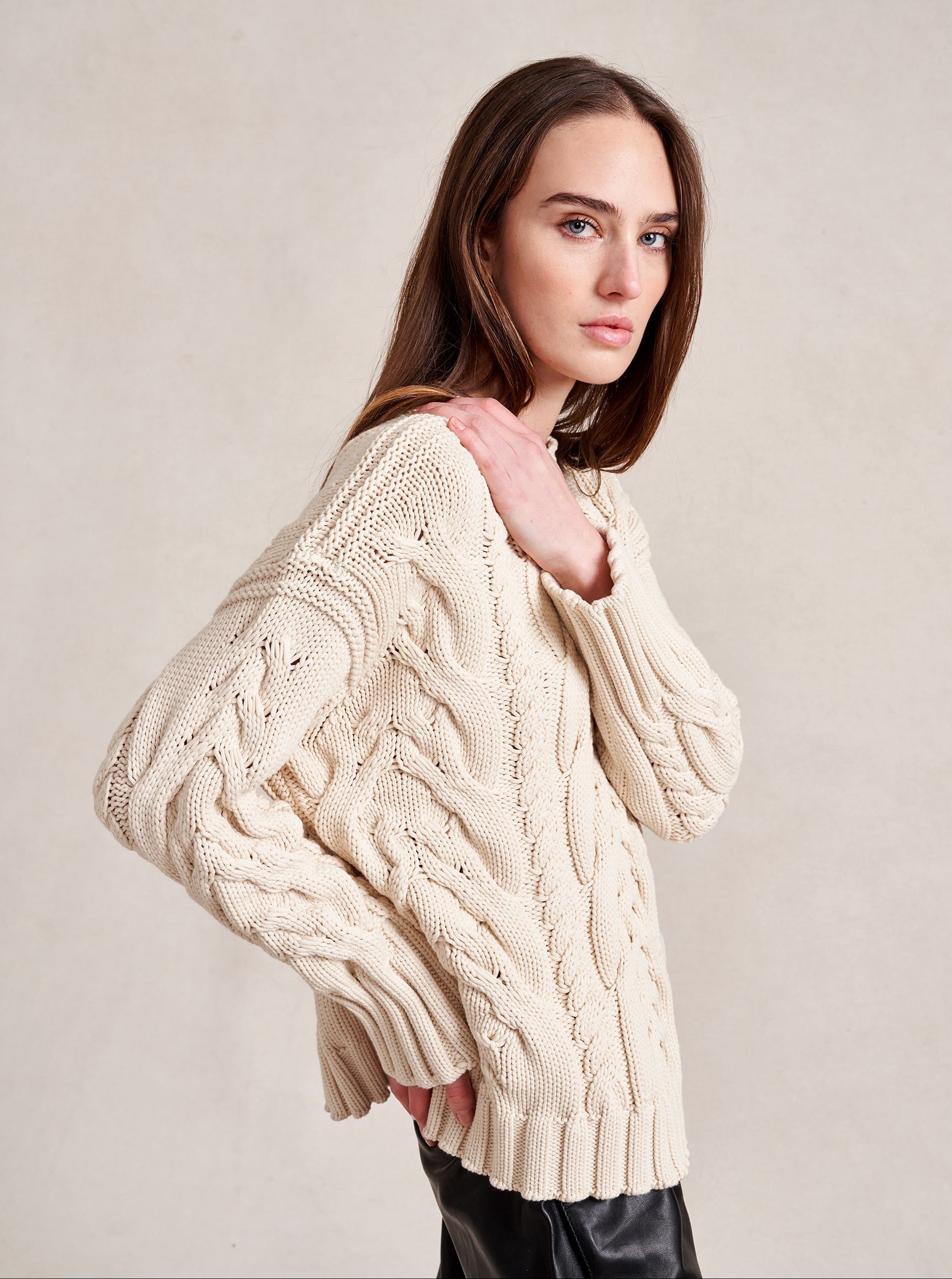
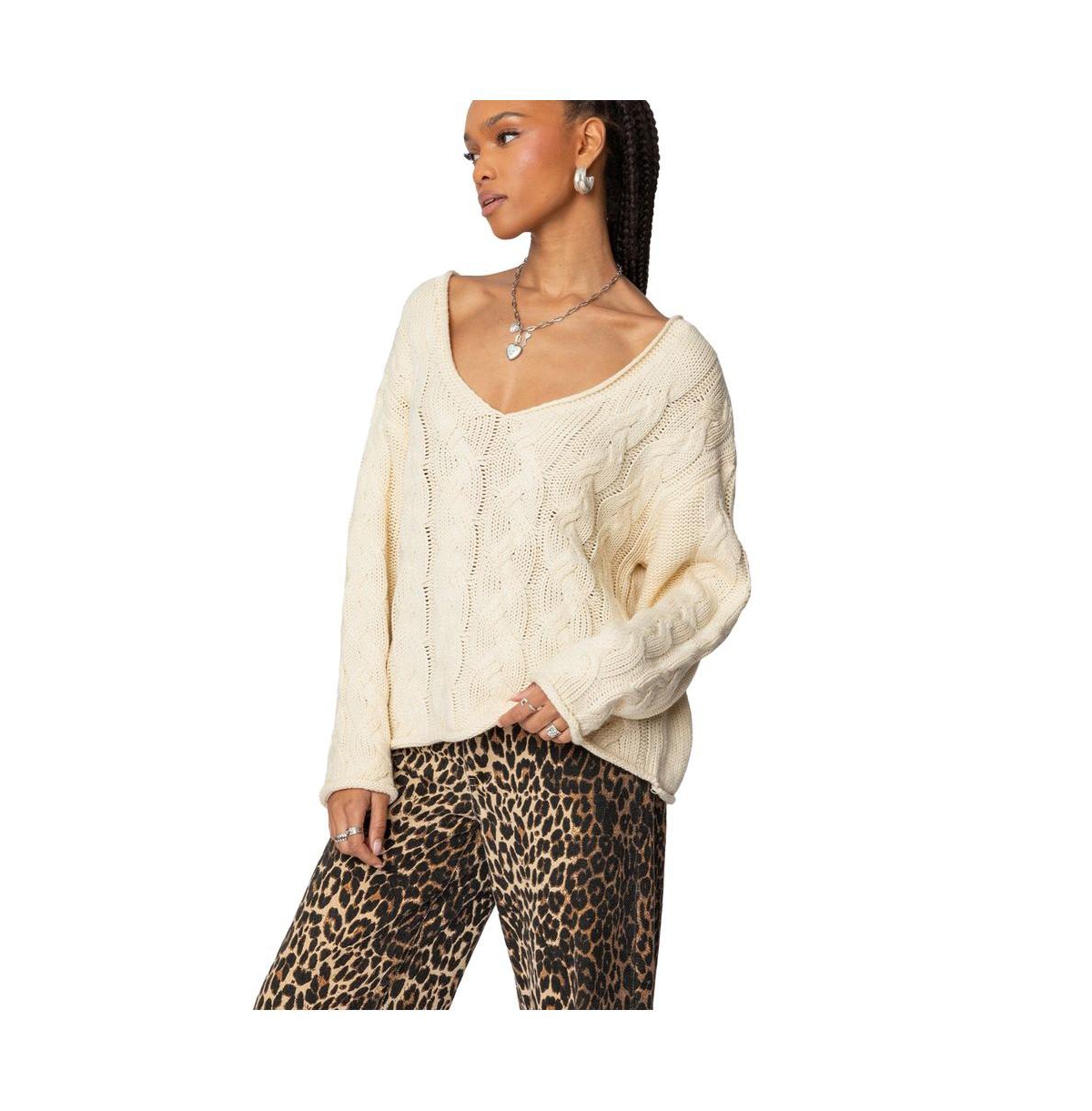
These landed at 0.33 to 0.35, lower than the leopard section and still coherent, which is the honest shape of the result. The cable pattern and the oversized cut carried the match; the colour contributed almost nothing, because cream is cream everywhere. Note the price gap too, $450 against $64.40 for the same silhouette, which is the gap the brand name was hiding.
The rule of thumb: the more three-dimensional a garment is, the better your odds. Cables, quilting, ruching, pleating and heavy weaves all give the model something to hold onto.
Hardware and cut settle the common colours
When the colour is generic, construction does the work. A beige trench is the classic example. Thousands exist, and the field still narrows once you look at button count, lapel width, the storm flap, the belt buckle, and where the belt loops sit.
Beige double breasted belted trench coat
Beige double-breasted trench coat, knee length, notch lapel, storm flap, buckled belt. Common colour, distinctive hardware and cut.
FetchFashion AI matched this in seconds
Try this with your outfit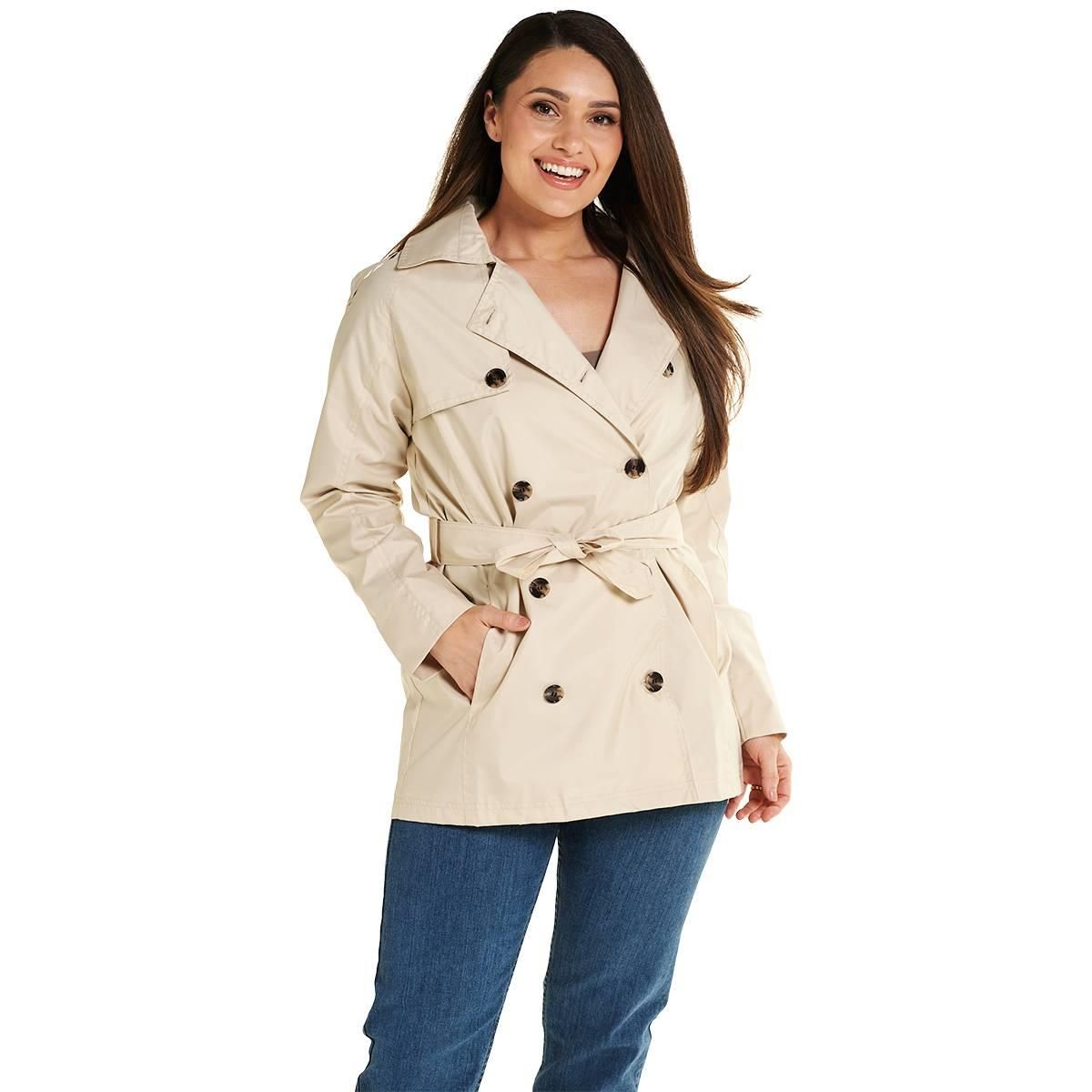
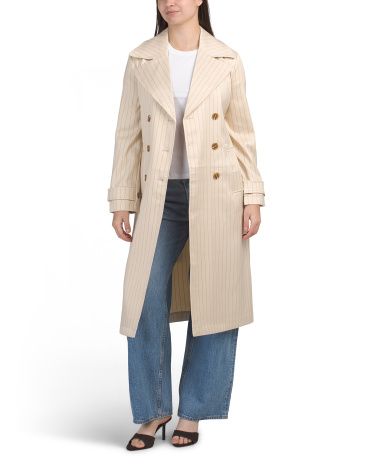
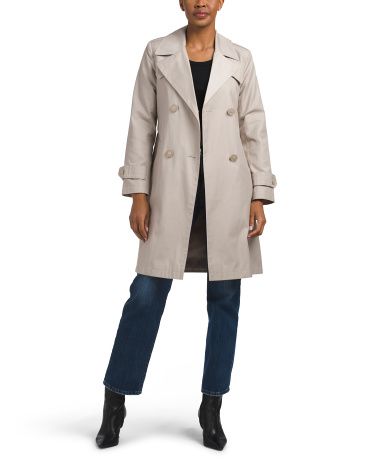
Those matched at 0.35 to 0.36 on structure rather than colour, from $39.99 to $69.99, and they hold together despite beige being the least distinctive shade in outerwear. If you are photographing a coat with the intention of identifying it, shoot it open and from the front and get the buttons in frame. That one choice changes the result more than any setting in the app. The same logic runs through bags and shoes, where hardware is often the only thing separating two identical silhouettes.
What defeats brand identification
Plain basics defeat it. So do heavy crops, motion blur, dark bar lighting, and any shot where the garment is half hidden behind an arm or a tote.
A plain black crew neck tee is the worst case by a distance. It has a neckline, a sleeve length, and a colour, and roughly every retailer on earth sells one. There is no fingerprint to match, so the results spread thin across near-identical products and no brand rises above the rest. I did not put a product grid in this section, and that is deliberate: the honest output for a photo like that is a shrug, not a shortlist dressed up as an answer.
The practical move is to stop hunting the label and start hunting the fit. Weight, neckline width, and hem length are what actually made you want that tee, and those you can shop for directly.
Brand-identification tools compared
The honest summary: no consumer tool reads clothing labels from a photo. Each one answers a different question, so pick by the question you actually have.
| Tool | What it answers | Brand naming | Price angle | Best for |
|---|---|---|---|---|
| FetchFashion | "What is this and where do I buy it or something like it" | Indirect, via matched products across 1,000+ retailers | Surfaces cheaper alternatives, prices in your currency | Getting a buyable result whether or not the brand is confirmed |
| Google Lens | "What exact item is this" | Strongest when the item is mass market and indexed | Sends you to the original at full retail | Putting a name to a widely sold piece |
| TinEye | "Where else has this exact photo appeared" | Only if the source page names the brand | None, it indexes images not products | Tracing a press or lookbook shot back to its source |
| Pinterest visual search | "What else looks like this" | Rarely, pins often carry no product data | None, inspiration rather than commerce | Mood-boarding the aesthetic |
| Reddit communities | "Can a human identify this" | Sometimes, and often correctly | Manual | Obscure pieces where crowd knowledge beats a model |
Two notes worth having. Reverse image search only works when your photo, or a near-identical one, already exists online, which rules out your own snapshot of a stranger on the street. And human communities genuinely outperform every model on archive pieces and tiny labels, at the cost of waiting a day for an answer.
What to do when the brand stays unknown
Buy the match, not the label. That sounds like a consolation prize and it isn't, because in most cases the brand name was never the goal. You saw a piece, you wanted the piece, and the brand was just the route you assumed you had to take to get it.
When the top matches agree, you have a probable brand and a shopping list. When they scatter, you have no brand and still a shopping list, and the second one is worth more than a name you cannot act on. That is the difference between a tool that identifies and a tool that gets you dressed.
The one thing I would not do is trust a confident brand answer pulled from a photo that could not possibly support it. Blurry, cropped, plain, badly lit: those photos have a correct answer, and the correct answer is "I don't know, but here are twelve things that look like it".
Frequently asked questions
How do I find the brand of clothes from a photo? Upload the photo to FetchFashion at fetchfashion.ai. The AI reads the silhouette, print, colour and fabric of each garment and returns visually similar products with their retailer and brand names attached. When the original piece is still on sale, its brand usually appears in the matches.
Can AI identify a clothing brand from a picture of the label? Not with FetchFashion. Our AI is a visual matcher, not a text reader, so it does not perform OCR on woven tags or logo recognition. It compares the garment itself against 1,000+ retailers. For a legible woven label, searching the text on the tag is faster.
Why does the AI show similar clothes instead of the exact brand? Because brand identification is an inference, not a lookup. Visual AI measures how closely a garment resembles products it can see for sale. If the exact piece is sold out, exclusive, or from a label with no online feed, the look-alikes are the honest answer.
What kind of photo gives the best chance of finding the brand? A clear, full-garment shot in even light, cropped to one piece. Distinctive prints, unusual colours, visible hardware and strong silhouettes raise match quality. Heavy crops, motion blur and plain basics lower it.
Is Google Lens better at identifying clothing brands? Google Lens is stronger at naming a mass-market item that is already indexed, and it sends you to that item at full price. FetchFashion finds cheaper alternatives; Google Lens finds the same item at full price. Use both, in that order.
Related reading
Found an outfit somewhere else?
Upload a screenshot and we find the match and track prices for you.
Try It FreeFAQ
How do I find the brand of clothes from a photo?
Upload the photo to FetchFashion at fetchfashion.ai. The AI reads the silhouette, print, colour and fabric of each garment and returns visually similar products with their retailer and brand names attached. When the original piece is still on sale, its brand usually appears in the matches. Free for 5 searches a day.
Can AI identify a clothing brand from a picture of the label?
Not with FetchFashion. Our AI is a visual matcher, not a text reader, so it does not perform OCR on woven tags or logo recognition on prints. It compares the garment itself against 1,000+ retailers. For a legible woven label, a plain web search of the text on the tag is the faster route.
Why does the AI show similar clothes instead of the exact brand?
Because brand identification is an inference, not a lookup. Visual AI measures how closely a garment resembles products it can see for sale, so it returns the closest buyable matches ranked by similarity. If the exact piece is sold out, exclusive, or from a label with no online feed, the look-alikes are the honest answer.
What kind of photo gives the best chance of finding the brand?
A clear, full-garment shot in even light, cropped to one piece. Distinctive prints, unusual colours, visible hardware and strong silhouettes all raise the match quality. Heavy crops, motion blur, dim light and plain basics lower it, because a black crewneck tee looks like ten thousand other black crewneck tees.
Is Google Lens better at identifying clothing brands?
Google Lens is stronger at naming a mass-market item that is already indexed, and it sends you to that item at full price. FetchFashion finds cheaper alternatives; Google Lens finds the same item at full price. Use Lens to put a name to a piece, then FetchFashion to find a version you will actually pay for.
Can I describe the piece in words instead of uploading a photo?
Yes. Ask Luna at fetchfashion.ai/en/chat takes plain-language requests like 'cream cable knit jumper with a boat neck, under 60 euros'. She searches 1,000+ retailers and returns buyable matches sorted cheapest first. No photo, no sign-up, free.
About the author
Luna
Tattoo Artist & Fashion Writer
Luna is the voice and curation behind FetchFashion blog posts. Thrift queen, screen-fashion obsessive, and the editorial eye that picks which outfits get the breakdown.
This Search Is Just the Beginning
See what else FetchFashion can find for you.
Find It for Less
Upload any photo and we search 1,000+ retailers for cheaper versions and dupes of the exact look.
Find it for lessEvery Piece, Detected
One photo, every item. Our AI spots each piece (top, bag, shoes) and searches for all of them at once.
Search a full outfitNo Photo? Ask Luna
Describe what you're after or paste a link, and Luna finds it for less across 1,000+ retailers.
Ask LunaSee an Outfit You Love?
Upload any screenshot and our AI finds where to buy it. Results in seconds, from 1,000+ stores, in your local currency.
5 free searches per day · no sign-up
You might also like
Find Shoes From a Photo: Free AI Search in 4 Steps
Upload a photo and find those shoes, or a cheaper pair. Follow 4 free steps, compare the tools, shop 397,892 pairs from 1,000+ retailers.
How to Find a Dupe of Any Item From a Photo
Upload a photo, get the cheaper dupe, not the full-price original. Follow 4 free steps to find a dupe of any item across 1,000+ retailers. Try it free.
How to Find Clothes From a Video (Free, 5 Steps)
Pause the frame, find the look. Follow 5 free steps to find clothes from any TikTok, Reels, or YouTube video, with cheaper look-alikes. Try it now.
How to Find Clothes From a Photo (Free, 4 Steps)
Upload a photo, get the outfit, or a cheaper version. Follow 4 free steps to find clothes from any picture across 1,000+ retailers. Try it now.